

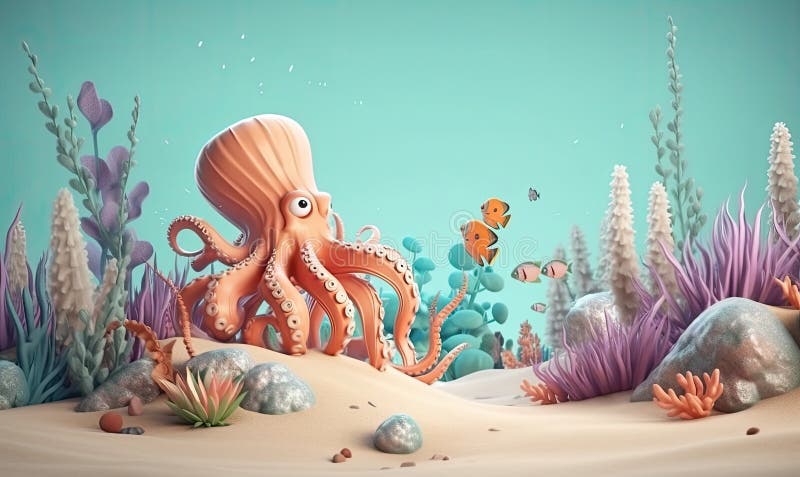
For decades, the animal kingdom’s tool-use club was considered exclusive. Humans, chimpanzees, orangutans, crows, and dolphins were the star members. The entry requirement was simple yet profound: the ability to use an external object to achieve a goal. This skill was once seen as a hallmark of high intelligence, advanced problem-solving, and even self-awareness. Then came the octopus a soft-bodied, boneless mollusk with a brain shaped like a donut and arms that think for themselves.
Recent groundbreaking research has revealed something astonishing: octopuses do not just use tools occasionally or after weeks of trial and error. They learn tool use rapidly, often within a single attempt or after observing a solution once. This discovery shatters previous assumptions about invertebrate intelligence and forces scientists to rethink how cognitive abilities evolve across completely different biological lineages.
In this article, we will explore the fascinating experiments that proved octopuses can learn tool use faster than many vertebrates, the biological mechanisms behind this talent, and what it means for our understanding of consciousness itself. We will also compare octopus learning to other intelligent animals, examine the ecological reasons for their rapid learning, and discuss the ethical implications of keeping such brilliant creatures in captivity.
What Is Tool Use? A Scientific Definition
Before diving into the octopus’s abilities, it is essential to define what scientists mean by “tool use.” Not every action involving an object qualifies. According to renowned ethologist Dr. Jane Goodall and subsequent researchers, tool use occurs when an animal uses an external object as a functional extension of its own body to achieve a goal, such as acquiring food, grooming, or defending itself.
The criteria for true tool use typically include:
A. The object must be unattached to the substrate or the animal’s body (no, a turtle’s shell does not count).
B. The animal must actively manipulate the object during or immediately before use.
C. The object serves a purpose that the animal’s own body cannot easily accomplish alone.
For example, when a sea otter uses a rock to crack open a clam, that is tool use. When a chimpanzee uses a stick to extract termites, that is also tool use. But when an octopus simply hides inside a shell, that is sheltering, not tool use. However, when an octopus picks up a coconut shell half, carries it under its body, and later reassembles it for protection that becomes tool use.
The rapid learning aspect is what makes octopuses so special. While great apes may take several attempts to master a new tool, octopuses have been observed solving similar problems in minutes.
The Landmark Experiment: Rapid Learning in Action
The most compelling evidence of rapid tool-use learning in octopuses comes from a series of studies conducted at marine laboratories in Australia, Germany, and the United States. One particularly famous experiment involved the veined octopus (Amphioctopus marginatus), a species already known for its remarkable behavior of collecting coconut shells to use as portable armor.
In the experiment, researchers presented captive octopuses with a problem: a tasty crab was inside a glass jar with a screw-top lid. The jar was placed inside the tank without any prior training. The octopuses had never seen a jar before. The question was simple would they figure out how to open it, and if so, how quickly?
The results were breathtaking. Within an average of 54 minutes on the first attempt, most octopuses learned to unscrew the lid. But the real surprise came in the second trial. When presented with the same jar a day later, the octopuses opened it in under five minutes. They had learned the necessary sequence of movements wrapping arms around the lid, applying torque in a specific direction, and pulling after just one successful experience.
In a separate experiment involving the common octopus (Octopus vulgaris), individuals were shown a transparent box containing food. The box could only be opened by pulling a red lever, then lifting a blue flap. Without any demonstration from humans, some octopuses solved the puzzle in under 10 minutes. Even more impressive, when these octopuses were placed in a tank with naïve octopuses separated by a clear divider, the observers learned the solution in under 15 minutes simply by watching.
These studies confirm that octopuses possess not only individual learning but also social observational learning a trait once thought unique to primates and birds.
Biological Foundations: Why Octopuses Learn So Fast
How can an animal without a backbone, with a nervous system organized completely differently from ours, learn tool use faster than many mammals? The answer lies in three unique biological features.
1. Distributed Intelligence
Unlike humans, who concentrate most of their neurons in a single brain, an octopus has approximately 500 million neurons but two-thirds of them are located in its arms. Each arm has its own mini-brain, capable of processing sensory information, making decisions, and even learning independently. When an octopus manipulates a tool, its central brain sends a high-level command like “open the jar,” but the arms figure out the precise motor sequence by themselves. This parallel processing allows for incredibly rapid trial-and-error learning without overloading the central brain.
2. High Neuronal Density and Plasticity
Octopus neurons, despite being invertebrates, show remarkable plasticity the ability to form new connections after a single learning event. This is rare even among vertebrates. Neurobiologists have observed that after an octopus successfully solves a novel problem, synaptic changes occur within hours, not days. This allows the animal to retain the solution for months without repetition.
3. Short Lifespan Pressures
Most octopus species live only one to two years. Many are semelparous, meaning they die shortly after reproducing. This compressed lifecycle creates intense evolutionary pressure to learn quickly. There is no time for extended childhoods or endless trial and error. An octopus that cannot figure out how to break into a crab’s shell or avoid a predator within minutes may not survive to reproduce. Rapid tool-use learning is, therefore, an adaptive necessity.
A Step-by-Step Breakdown of Octopus Tool-Use Learning
To understand just how fast octopus learning is, let us compare it to the learning curve of other intelligent animals. The following sequence illustrates a typical first encounter between an octopus and a novel tool-based problem.
Step A — Initial Exploration (0–2 minutes)
The octopus extends one or two arms toward the object. The arm’s chemotactile receptors (taste-by-touch cells) analyze the surface. The octopus determines if the object is edible, threatening, or neutral. If it contains food, the octopus’s curiosity intensifies.
Step B — Tentative Manipulation (2–10 minutes)
The octopus wraps arms around the object in different configurations. Each arm acts semi-autonomously. If the object is a jar, one arm may pull the lid while another pushes the body in the opposite direction. The octopus does not yet understand the mechanism but is systematically varying its actions.
Step C — Accidental Discovery (10–30 minutes)
At some point, one of the arm movements produces a result for example, the lid rotates slightly. The octopus detects this change through proprioception (sensing the position of its arms). This accidental success triggers immediate attention.
Step D — Focused Repetition (30–60 minutes)
Once a successful movement is discovered, the octopus repeats it, but not blindly. It modulates the force and angle. Within minutes, the octopus refines the movement into a reliable sequence. Learning has occurred in a single session.
Step E — Consolidation and Retention (next day)
When presented with the same tool again, the octopus executes the solution within seconds to minutes. Moreover, octopuses have been shown to generalize if they learned to unscrew a round lid, they can apply the same twisting motion to a hexagonal lid without retraining.
For comparison, a rat might take several days of reinforcement to learn a similar multi-step manipulation. A crow might learn after 2–3 attempts. An octopus often learns after one.
Documented Examples of Octopus Tool Use in the Wild
Laboratory experiments are impressive, but wild octopuses demonstrate tool use in even more creative ways. Marine biologists have documented the following behaviors:
A. Coconut Shell Armor — The veined octopus has been filmed collecting discarded coconut shell halves, stacking them, and carrying them under its body while crawling across open sand. When threatened, it assembles the two halves around itself like a protective clamshell. This is tool use because the octopus carries and reassembles the shells for future use, not just immediate shelter.
B. Rock Anchoring — Some octopus species collect small rocks and pebbles, then use them to anchor the entrance of their dens against strong currents or predators. They also throw rocks at intruding octopuses a rare example of projectile tool use in invertebrates.
C. Jellyfish Tentacle Harvesting — In a truly astonishing observation, a wild octopus was seen approaching a Portuguese man o’ war (a venomous siphonophore), carefully severing one of its stinging tentacles, and then using the detached tentacle as a weapon to hunt fish. The tentacle’s nematocysts (stinging cells) remained active, giving the octopus a venomous tool.
D. Shell Manipulation for Hunting — Octopuses frequently use shells, bottles, or even discarded human trash to trap small prey. They will cover a crab’s burrow with a large shell, then wait until the crab pushes against it from below, at which point the octopus flips the shell and grabs the exposed crab.
Each of these examples required not just strength or instinct, but rapid problem-solving. In most cases, the octopus had never encountered that specific object before yet figured out its utility within minutes.
Comparing Octopus Rapid Learning to Other Animals
To appreciate how extraordinary octopus learning is, let us compare tool-use acquisition speeds across species.
| Animal | Average Number of Trials to Master a Novel Tool | Learning Type |
|---|---|---|
| Chimpanzee | 2–5 trials with demonstration | Social/Individual |
| New Caledonian Crow | 1–3 trials (if tool is natural, like twigs) | Individual/Innovation |
| Dolphin | 3–8 trials with reinforcement | Social/Individual |
| Rat | 15–30 trials (for multi-step manipulation) | Reinforcement |
| Octopus | 1–2 trials (often 1 successful attempt) | Individual/Observational |
The octopus is unique because its first successful attempt is usually enough for permanent learning. Most vertebrates require repeated positive reinforcement. An octopus, however, appears to treat tool-use problems as puzzles to be solved conceptually, not as behaviors to be conditioned.
Dr. Jennifer Mather, a leading cephalopod researcher, noted that octopuses “seem to understand the cause-and-effect relationship immediately once they stumble upon it.” This suggests a level of causal reasoning that was previously attributed only to great apes and corvids (the crow family).
Neural Mechanisms Behind Rapid Learning
What is happening inside an octopus’s brain during rapid tool-use learning? Recent neuroimaging studies (adapted for octopus physiology) reveal a fascinating process.
The Vertical Lobe — This is the octopus equivalent of the mammalian prefrontal cortex, responsible for decision-making and learning from mistakes. When an octopus tries an ineffective action, the vertical lobe suppresses that motor pattern. When an action succeeds, the vertical lobe releases neurotransmitters that strengthen the connection between the central brain and the arm ganglia.
The Optic Lobes — Octopuses have excellent vision, and their optic lobes process visual information in parallel with arm sensory data. When watching another octopus solve a puzzle, the observer’s optic lobes activate the same neural patterns as if it were performing the action itself a phenomenon similar to mirror neurons in humans.
Arm Autonomy — Crucially, once an arm ganglion learns a motor sequence (like twisting a lid), it stores that memory locally. The central brain does not need to micromanage every movement. This means learning is faster because the learning load is distributed across eight independent processors.
In practical terms, this neural architecture allows an octopus to learn a new tool-use skill in the time it takes a human to learn a simple piano chord minutes, not days.
Ecological and Evolutionary Reasons for Rapid Learning
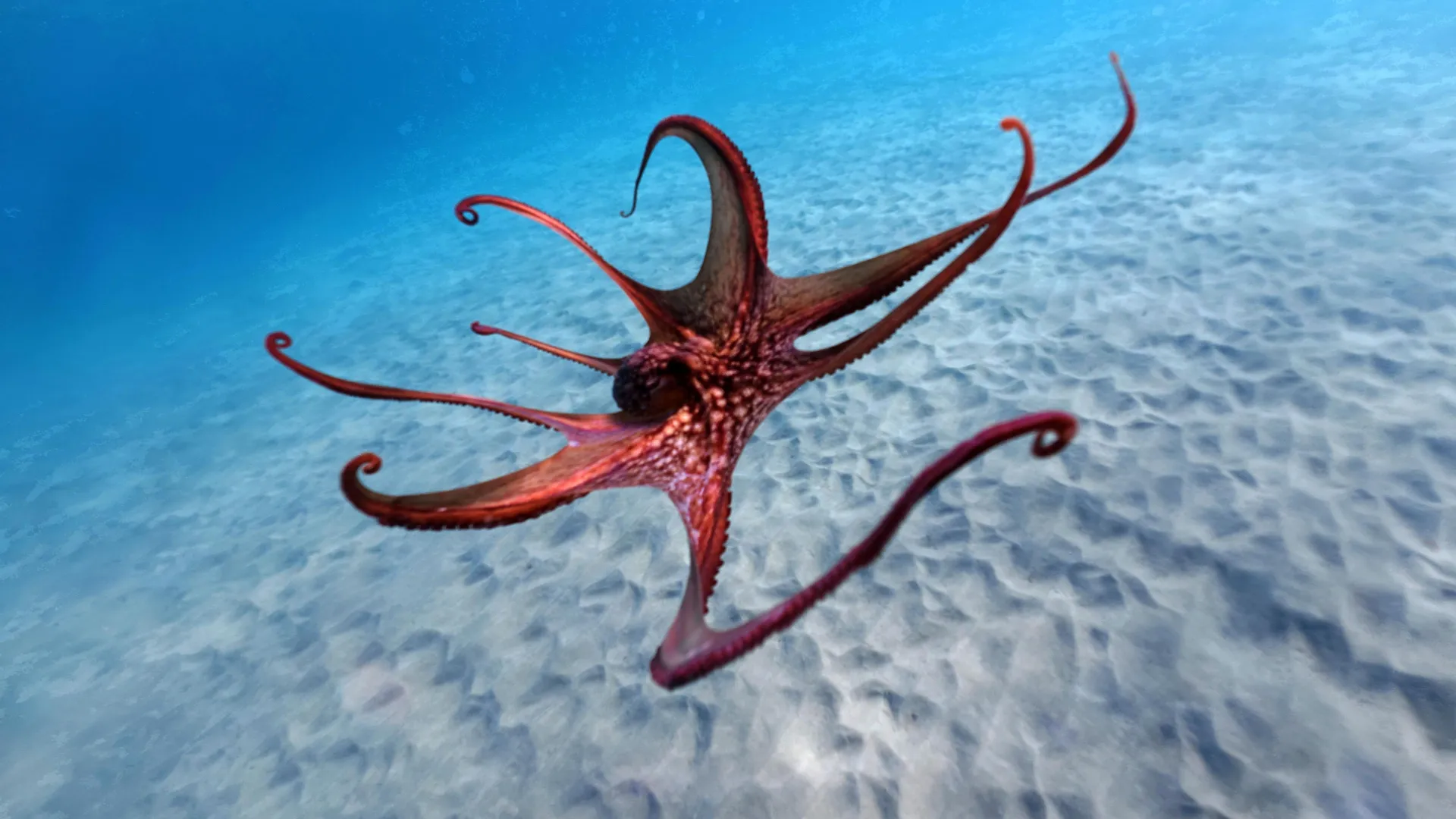
Why would evolution favor such rapid learning in a mollusk? Several ecological pressures explain this adaptation.
A. Lack of Physical Defense — Unlike clams with hard shells or squid with speed and ink clouds, many octopus species are soft, slow (on land), and vulnerable. Their primary defense is intelligence. Tool use allows them to compensate for their physical weaknesses.
B. Complex Predator-Prey Dynamics — Octopuses hunt crabs, lobsters, and bivalves, all of which have tough exteriors or defensive behaviors. A crab’s pincer or a clam’s sealing muscle requires strategy to overcome. Tool use such as inserting a small pebble to keep a clam from closing provides a solution.
C. Rapidly Changing Environments — Octopuses live in intertidal zones, coral reefs, and seagrass beds where tides, currents, and seasonal changes constantly alter the landscape. A fixed instinct would fail. Rapid learning allows them to adapt on the fly.
D. Short Reproductive Window — Since most octopuses die after spawning at around one year of age, any individual that wastes weeks learning a skill may never reproduce. Natural selection has therefore favored those with the fastest learning curves.
Ethical Implications for Captivity and Research
The discovery that octopuses learn tool use rapidly has significant ethical consequences. For years, octopuses were kept in relatively barren laboratory tanks or small home aquariums. Now we know that a bored octopus is a suffering octopus.
Consider the following ethical points:
A. Environmental Enrichment — Any captive octopus must be provided with novel objects, puzzle feeders, and tools to manipulate. Without mental stimulation, octopuses exhibit stereotypic behaviors (pacing, self-mutilation) indicative of psychological distress.
B. Regulatory Status — In 2021, the United Kingdom officially recognized octopuses, squid, and cuttlefish as sentient beings under the Animal Welfare (Sentience) Act. Similar protections are being debated in the European Union and parts of the United States. This recognition is largely due to evidence of rapid learning and tool use.
C. Research Ethics — Experiments that involve depriving octopuses of tools or presenting unsolvable puzzles may now be considered unethical in many jurisdictions. Researchers must use positive reinforcement only and allow octopuses to withdraw from studies.
D. Dietary Choices — As consumers become aware of octopus intelligence, demand for wild-caught octopus may decline. Some environmental groups now recommend avoiding octopus consumption entirely unless sourced from certified ethical fisheries that use non-stressful capture methods (which are rare).
Common Misconceptions About Octopus Tool Use
Despite growing awareness, several myths persist. Let us clarify them:
A. Myth: Octopuses only use tools in laboratories.
Fact: Wild octopuses have been observed using tools in Indonesia, Australia, the Mediterranean, and the Pacific Northwest. Coconut shell carrying was filmed in the wild, not a lab.
B. Myth: Tool use is instinctive for octopuses.
Fact: While some sheltering behaviors may be innate, the specific use of novel objects (plastic bottles, glass jars, Legos) requires learning. Octopuses raised in isolation still figure out tools, but they learn faster if they observe others.
C. Myth: Only large octopuses use tools.
Fact: Even the tiny star-sucker pygmy octopus (Octopus wolfi), which grows to less than an inch, has been seen manipulating sand grains and small shells to build hunting blinds.
D. Myth: Octopuses forget tool-use skills quickly.
Fact: Studies show retention of tool-use skills for at least three months without practice. Given their one-year lifespan, this represents a significant portion of their life.
Future Research Directions
The rapid learning ability of octopuses opens exciting new research avenues:
A. Comparative Cognition — Scientists are now comparing octopus learning to that of cephalopods’ close relatives, such as cuttlefish and squid, to understand when tool use evolved.
B. Artificial Intelligence — Octopus arm autonomy is inspiring new approaches in soft robotics and distributed AI systems. Engineers are developing “octopus-like” robots that learn motor tasks without central programming.
C. Long-term Memory Studies — Researchers want to know if octopuses can pass learned tool-use skills to their offspring. Since most die before their young hatch, direct teaching is impossible, but epigenetic inheritance of learning capacity is being studied.
D. Climate Change Impact — Rising ocean temperatures and acidification affect octopus neural development. Researchers are testing whether warmer waters slow their rapid learning abilities, which could have devastating ecological consequences.
Practical Tips for Aquarists and Educators
If you keep an octopus in a research or educational setting, here are evidence-based recommendations for encouraging natural tool-use learning:
A. Provide a “tool box” of safe objects plastic jars with loose lids, clean coconut shells, smooth pebbles, and PVC elbows.
B. Rotate objects every 48 hours to prevent habituation but keep one familiar tool to test retention.
C. Never use live vertebrate prey for tool-use training (illegal in many regions and ethically questionable). Use frozen-thawed crab or shrimp inside puzzle feeders.
D. Record learning times. If an octopus fails to solve a novel tool problem within 2 hours, reduce difficulty the goal is enrichment, not stress.
E. Observe from a distance or through one-way glass, as octopuses are neophobic (afraid of new things) when a human is present.
Conclusion: Rethinking Intelligence on Earth

The octopus stands as a living proof that intelligence does not need bones, a long lifespan, or a vertebrate nervous system. Learning tool use rapidly often in a single attempt places octopuses in the highest echelon of animal cognition alongside chimpanzees, dolphins, and crows. Yet they evolved along a completely separate evolutionary path for over 500 million years.
This convergent evolution of intelligence suggests that complex problem-solving and tool use may be inevitable outcomes for any animal that faces ecological pressures similar to those of early primates. If octopuses can learn so quickly with such a different brain, then our human-centric view of intelligence is not just arrogant but scientifically inaccurate.
As we continue to study these remarkable creatures, one thing is certain: the next time you see an octopus in an aquarium or documentary, remember that you are looking at an animal that can figure out in minutes what would take most other animals days to learn. It is not just surviving. It is thinking, planning, and using tools with a speed that should command our respect, our wonder, and our ethical responsibility.