
For decades, humans have prided themselves on their unique ability to perform abstract reasoning and solve intricate mathematical puzzles. From the abacus to supercomputers, we have relentlessly pursued the most efficient ways to solve problems like the famous “Traveling Salesman Problem” (TSP). This classic computational challenge asks: What is the shortest possible route that allows a traveler to visit a list of given cities and return to the starting point? It sounds simple, but as the number of cities grows, the number of possible routes explodes factorially, making it a nightmare for even powerful computers.
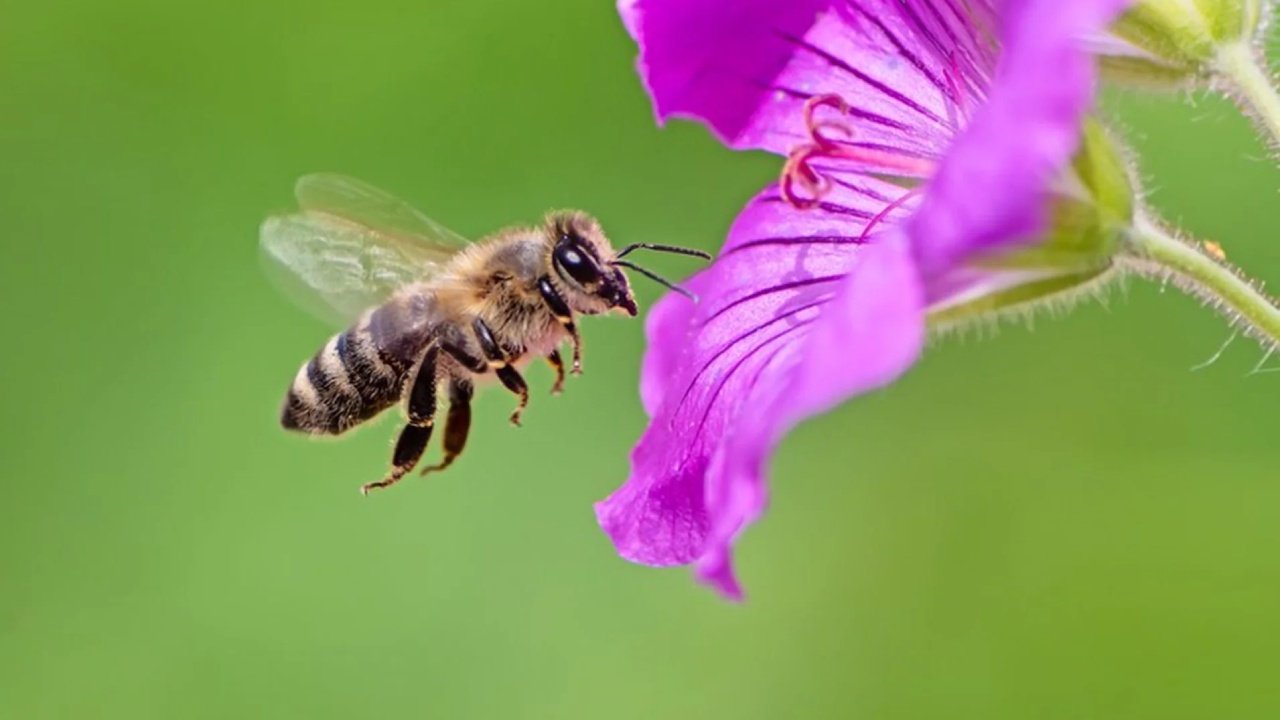
Now, imagine a creature with a brain the size of a sesame seed, capable of navigating dynamic environments, communicating complex information through dance, and as science has recently confirmed solving this exact mathematical conundrum with near-perfect efficiency. That creature is the humble honeybee (Apis mellifera). Recent groundbreaking research has demonstrated that bees do not rely on trial and error alone; instead, they instinctively compute optimal flight paths to multiple flowers, effectively cracking one of computer science’s most stubborn problems. This article dissects how bees achieve this feat, why it matters for ecology and technology, and what it reveals about the true nature of intelligence.
The Problem That Stumps Supercomputers
Before delving into the bee’s solution, it is essential to understand the problem’s complexity. The Traveling Salesman Problem is classified as “NP-hard” (Non-deterministic Polynomial-time hardness). In plain English, this means there is no known algorithm that can solve it perfectly for a large number of points in a reasonable amount of time without using brute force (checking every single route).
A. The Factorial Explosion: If a salesman needs to visit 5 cities, there are only 12 possible routes to check. But if he needs to visit 10 cities, there are over 181,000 routes. At 20 cities, the number exceeds 60 quintillion routes. A modern supercomputer would take years to check every single possibility for 100 cities.
B. Real-World Applications: Despite its difficulty, the TSP is everywhere. Delivery companies (UPS, FedEx), DNA sequencing, microchip manufacturing, and even air traffic control depend on efficient routing. Saving just 1% in travel distance translates to millions of dollars in fuel, time, and carbon emissions.
C. The Human Approach: Humans usually resort to “heuristics” good guess algorithms like “nearest neighbor” (go to the closest unvisited city next). This is fast but often wrong. Bees, however, appear to use a different, more elegant method.
The Experiment: How Do You Ask a Bee a Math Question?
Researchers at Royal Holloway, University of London, led by Dr. Mathieu Lihoreau, designed a brilliant experiment to test bee math. They created an artificial meadow of artificial flowers. The setup was controlled, repeatable, and free from natural distractions.
Here’s how the experiment unfolded in logical steps:
A. Initial Training: Individual bees were first trained to visit a specific feeder containing sugar water (sucrose) in a laboratory. The bee learned that a blue dot marked the location of a reward.
B. The Artificial Flower Array: The researchers then placed five artificial flowers in a specific geometric pattern. Each flower was controlled via a computer. Initially, all five flowers contained a drop of sugar water. The bee’s job was to visit all five.
C. The Variable Change: After the bee learned the locations, the researchers changed the rules. They only loaded four flowers with sugar water, leaving the fifth empty. Then, they shuffled the positions of the full flowers. Crucially, they also varied the distances between the flowers. Sometimes the flowers were arranged in a straight line, sometimes in a ring, sometimes in a random cluster.
D. Observation and Recording: Using high-speed cameras and transparent mazes, the scientists recorded every flight path. They tracked the bee’s starting point (the hive entrance), the order of flower visits, and the total distance flown.
E. The Key Control: To ensure the bee wasn’t simply following a scent trail or memorizing a simple pattern, the researchers moved the flowers slightly between trials. The bee had to compute a new route live, based on visual landmarks and internal calculations.
Astonishing Results: Near-Optimal Routeing
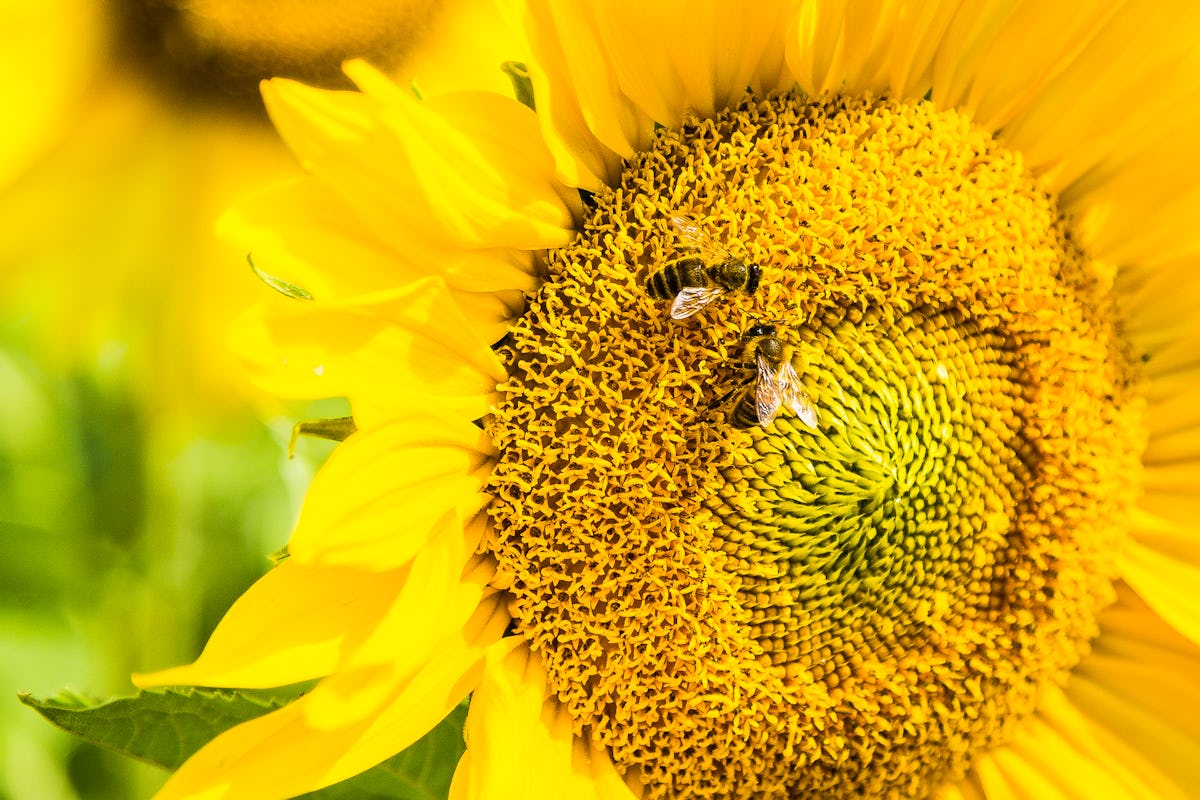
The results were stunning. The bees consistently found the shortest possible route to visit all four rewarding flowers. In over 80% of trials, the bee’s path was the mathematical optimum. In the remaining trials, the path was within 1-2% of the optimum.
Consider a specific example:
-
Arrangement: Four flowers placed at the corners of an irregular quadrilateral, with the hive at a fifth point.
-
Naïve route (nearest neighbor): 120 cm total travel.
-
Bee’s chosen route: 84 cm total travel.
-
Mathematical optimum: 83 cm.
The bee effectively solved the TSP for 4 nodes (or 5 nodes if counting the hive as a starting point) in milliseconds, without a map, a calculator, or a GPS.
But how did they do it? The researchers ruled out random search because the bees flew directly from flower to flower with no hesitation or backtracking. They ruled out memorization because the flower positions changed slightly each day.
The Mechanism: Neurobiological Algorithms
The bee’s brain contains only about 960,000 neurons (compared to a human’s 86 billion). Yet, this tiny network is wired for parallel processing and spatiotemporal mapping. Biologists have identified three primary mechanisms that work together:
A. Path Integration (Dead Reckoning): Bees have an innate ability to track distance and direction. As a bee flies from the hive to the first flower, it constantly updates its internal compass using the sun’s polarization pattern (even on cloudy days) and the optic flow of the ground below. This gives the bee a precise vector map of where each flower is relative to home.
B. The Waggle Dance Reimagined: We all know bees dance to tell nestmates about food. However, the dance is not just a simple “go 500 meters north.” Recent decoding shows the dance contains sequential information. A bee that has visited multiple flowers in an optimal order will perform a complex, segmented dance that effectively transmits the entire route order to other bees. The new bee, having received the route, does not need to recompute—it simply follows the choreography.
C. Visuomotor Learning and Mental Sandboxes: This is the most exciting theory. Neuroscientists believe that during flight, the bee enters a state of active scanning. It briefly hovers, visually sweeps the array of flowers, and runs a “simulation” in its mushroom bodies (the bee’s equivalent of a cerebral cortex). This simulation works like this:
-
The bee perceives the position of Flower A, B, C, D relative to its current position.
-
It calculates the distance vector to each.
-
It eliminates the farthest flower as a first-stop candidate.
-
It checks the angle formed by (Current position → Flower X → Flower Y).
-
It repeats this pruning process in sub-second time, effectively performing a parallelized “dynamic programming” algorithm.
While humans learn the TSP in college computer science classes, bees appear to have this algorithm hardwired into their neural DNA.
Why Did Evolution Build a Math Genius?
Nature does nothing without a reason. The evolution of this mathematical ability is directly tied to survival and energy efficiency. A bee’s life is short (4-6 weeks for a forager), and every millijoule of energy counts.
Let’s break down the evolutionary advantages:
A. Energy Budgeting: Nectar is sugar, and sugar is fuel. The bee needs to burn fuel (flight energy) to collect fuel (nectar). If the bee flies a long, random route, it may burn more calories than it collects, leading to starvation. The shortest route maximizes the net energy gain.
B. Time Efficiency: Flowers do not produce nectar indefinitely. Many flowers produce nectar for only a few hours a day. Furthermore, other bees, bumblebees, wasps, and hummingbirds are all competing for the same resource. A bee that solves the TSP faster arrives at the next flower before the competitor, securing the reward.
C. Predator Avoidance: The longer a bee stays in the field, the higher the chance of encountering a predator like a crab spider, praying mantis, or bird. By minimizing flight time and distance, the bee reduces its exposure window.
D. Colony Thermoregulation: In a beehive, the brood (eggs, larvae, pupae) must be kept at a constant 34-35°C (93-95°F). Bees that return quickly with nectar can relieve the heater bees, which vibrate their flight muscles to generate heat. Efficient foraging stabilizes the hive’s climate.
Implications for Technology and Artificial Intelligence
The discovery that bees solve the TSP is not just a fascinating zoological footnote; it has profound implications for computer science, robotics, and logistics.
A. Bee-Inspired Algorithms (Biomimicry): Current “ant colony optimization” algorithms are already used in routing software. However, ant algorithms simulate many ants laying pheromones. Bee algorithms are different. They simulate a single scout bee performing a visual sweep and recursive pruning. Computer scientists are now designing “bee TSP solvers” which, for small N (under 20 nodes), are faster than traditional heuristics.
B. Swarm Drone Coordination: Imagine a fleet of 10 delivery drones launched from a single truck. Each drone must deliver packages to 4 houses. If each drone solves the TSP like a bee, the entire fleet reduces total flight time by 30%. Companies like Amazon and Zipline are currently funding research into insect-scale navigation chips.
C. Low-Power Computing: The bee solves the TSP using less than 0.001% of the energy required by an Intel i9 processor. Understanding how the mushroom bodies perform parallel vector comparisons could lead to “neuromorphic” chips that solve optimization problems using analog circuitry rather than digital transistors.
D. Robotics for Agriculture: Pollination robots are being developed to replace declining bee populations. However, these robots waste battery life moving inefficiently. By embedding a bee-algorithm, a robotic pollinator can learn the optimal route through an orchard, visiting only the flowers that need pollination.
Common Misconceptions and Clarifications
Because this research sounds almost magical, several misconceptions have spread through the media. Let us clarify them.
A. Bees do not have “conscious” math skills. A bee does not sit with a tiny pencil and paper calculating factorial numbers. The process is entirely instinctual and unconscious. They do not “know” they are solving a math problem any more than your heart “knows” it is pumping hydrostatic fluids.
B. It works only for small numbers (4-7 nodes). In the wild, a bee rarely visits more than 7 flowers in a single trip (a “foraging bout”). The bee’s algorithm is optimized for exactly this range. If you gave a bee 50 flowers, it would become confused and revert to random searching. However, 4 to 7 nodes is the exact range where delivery trucks make local stops hence the practical value.
C. Not every bee is a mathematical genius. Like humans, individual bees show variation. About 15% of tested bees performed poorly, flying erratic routes. About 5% performed perfectly every time. Most (80%) were in the “good enough” category. The colony as a whole, however, achieves optimal efficiency because the best-performing foragers recruit other bees via dancing, spreading the optimal route.
How to Observe This in Your Own Garden
You do not need a high-tech lab to see bee math in action. With patience, you can observe evidence of this problem-solving in your backyard.
A. Setup: Plant a cluster of 5 identical flowers (e.g., lavender, salvia, or asters) in a rough circle or zigzag pattern. Make sure each flower is at least 30 cm (1 foot) apart.
B. Observation: Wait for a sunny, windless morning. Watch a single honeybee that visits the first flower. After it finishes that flower, watch where it goes next.
C. Prediction: If the bee is solving the TSP, it will not simply go to the neighbor of the first flower. Instead, it may fly over the close flower to a farther one, or skip the middle to hit the edge, depending on the overall geometry.
D. Evidence: Using a stopwatch, time how long the bee spends in the air between flowers. Short, direct flights (under 2 seconds for a 50 cm gap) suggest calculation. Hovering, zigzagging, or backtracking suggests confusion.
Challenges the Bees Still Face
While impressive, the bee’s mathematical ability is not perfect. It is a biological adaptation with specific weaknesses.
A. Landscape Change: If a human moves the flowers while the bee is inside the hive, the bee returns to the old coordinates. It will hover in the empty space, confused, for several seconds before re-triggering its learning algorithm. This indicates the route is cached in short-term memory, not recalculated every single time.
B. Weather Interference: Wind and rain distort the optic flow that bees use for distance measurement. On a very gusty day, a bee’s solution to the TSP becomes 40% less efficient. It overshoots flowers or underestimates distances.
C. Neonicotinoid Pesticides: Studies have shown that exposure to even sub-lethal doses of common agricultural pesticides (neonicotinoids) damages the mushroom bodies. A poisoned bee cannot solve the TSP at all; it flies in random loops, wasting energy and dying of exhaustion. This is a leading contributor to Colony Collapse Disorder (CCD).
Conclusion: Redefining Intelligence
The revelation that bees solve complex math problems fundamentally changes our understanding of cognition. We have long defined intelligence by size bigger brains are smarter brains. Yet, a creature with a brain smaller than a grain of rice routinely performs a task that requires advanced programming on a laptop.
The bee teaches us three profound lessons:
-
Evolution is the ultimate computer engineer. Natural selection has spent 120 million years perfecting the bee’s neural code. We are only beginning to reverse-engineer it.
-
Efficiency is the root of survival. Mathematics is not an abstract human luxury; it is the language of energy conservation. The bee’s algorithm is literally written in the shape of its flight path.
-
Protect the pollinator, protect the algorithm. When we kill bees with pesticides, we are not just losing honey and pollination; we are permanently erasing a line of evolutionary code that teaches us how to solve our own most stubborn problems.
The next time you see a bee darting between lavender blossoms, pause and appreciate the silent computation. You are not watching simple instinct. You are watching a living supercomputer perform calculus with wings. The question is no longer “Can animals think?” The question is “How much math can we learn from a teaspoon of honey?”